





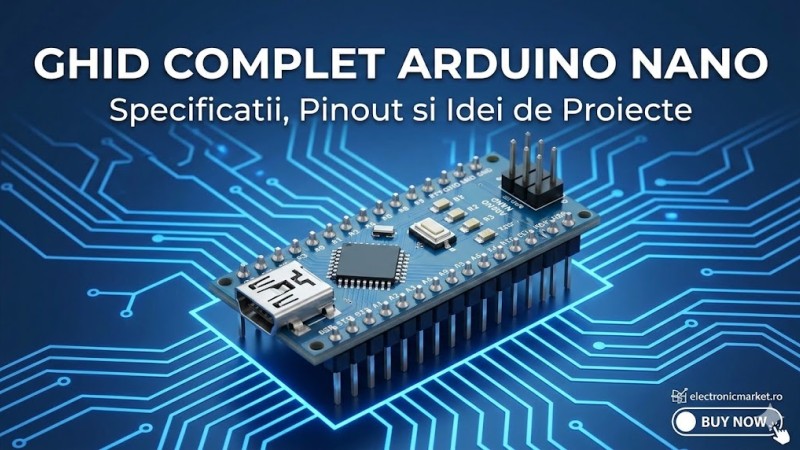
Arduino Nano: The Complete Guide for Small-Scale Electronics Projects
The Arduino Nano is a compact, versatile, and breadboard-friendly board based on the ATmega328P microcontroller. In this Arduino Nano guide, we explore why this tiny powerhouse is the preferred choice for engineers and hobbyists who need the functionality of an Uno in a much smaller footprint. Whether you are building a wearable device or a compact sensor node, the Arduino Nano offers the perfect balance of power and portability for your next electronic masterpiece.
Technical Specifications
Despite its small size, the Nano packs a punch. Here are the core technical details:
- Microcontroller: ATmega328P
- Operating Voltage: 5V
- Input Voltage (recommended): 7V - 12V
- Digital I/O Pins: 14 (of which 6 provide PWM output)
- Analog Input Pins: 8
- DC Current per I/O Pin: 40 mA
- Flash Memory: 32 KB (2 KB used by bootloader)
- SRAM: 2 KB
- EEPROM: 1 KB
- Clock Speed: 16 MHz
Arduino Nano vs. Arduino Uno
Choosing between these two boards often comes down to the physical constraints of your project.
- Size: The Nano is significantly smaller and plugs directly into a breadboard, whereas the Uno requires jumper wires.
- Analog Inputs: Surprisingly, the Nano has 8 analog inputs compared to the Uno's 6.
- Power: The Uno has a DC barrel jack, while the Nano is powered via Mini-B USB or the VIN pin.
- Performance: Both use the ATmega328P, so code performance is identical.
When Should You Use It?
The Arduino Nano is the ideal choice for several specific scenarios:
- Space-Constrained Projects: Perfect for wearables, small drones, or miniature robots.
- Breadboard Prototyping: Its pin headers allow it to sit directly on a breadboard, making circuit testing much cleaner.
- Permanent Installations: Because of its lower cost and smaller size, it is easier to "embed" into a finished product than an Uno.
- Multiple Sensors: With two extra analog pins, it handles complex sensor arrays slightly better than the Uno.
Conclusion
The Arduino Nano remains a staple in the world of DIY electronics due to its reliability and form factor. It provides all the power of the Arduino ecosystem without the bulk, making it a "must-have" in every maker's toolbox.
Ready to start your next compact project? You can find the Arduino Nano and all compatible sensors right here in our shop. Explore our collection and bring your ideas to life today.