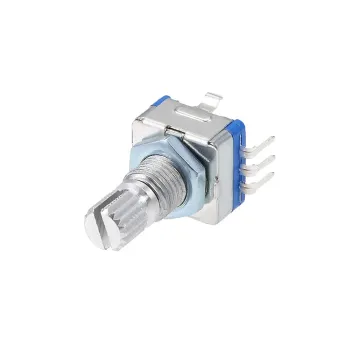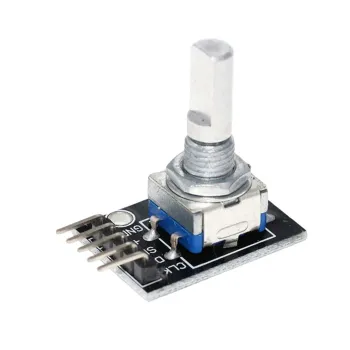


Explore rotary encoders for electronic projects, control panels, Arduino applications and embedded systems. Rotary encoders convert rotational movement into electrical signals and are commonly used for position detection, menu navigation, volume control and user input interfaces.
Choose the appropriate rotary encoder according to shaft type, number of pulses, mechanical dimensions, mounting style and integrated push-button function. Models such as incremental encoders are suitable for prototypes, control circuits and custom electronic devices.
How to Choose a Rotary Encoder
When selecting a rotary encoder, consider the shaft dimensions, pulse or detent count, output type, mounting method and whether an integrated push button is required. These characteristics determine how the encoder interacts with the electronic circuit and user interface.
Rotary encoders are commonly used with microcontrollers, development boards, control panels, audio equipment and embedded systems. Incremental rotary encoders can detect rotation direction and relative position, making them suitable for menus, parameter adjustment and digital controls.
For detecting position, movement and user input in electronic projects, explore the position and motion sensors category.